
How to use ListView in React Native - ListView

In this chapter, we will show you how to create a list in React Native. We will import List in our Home component and show it on screen.
App.js
import React from 'react'
import List from './List.js'

const App = () => {
   return (
      <List />
   )
}
export default App
To create a list, we will use the map() method. This will iterate over an array of items, and render each one.
List.js
import React, { Component } from 'react'
import { Text, View, TouchableOpacity, StyleSheet } from 'react-native'
   
class List extends Component {
   state = {
      names: [
         {
            id: 0,
            name: 'Ben',
         },
         {
            id: 1,
            name: 'Susan',
         },
         {
            id: 2,
            name: 'Robert',
         },
         {
            id: 3,
            name: 'Mary',
         }
      ]
   }
   alertItemName = (item) => {
      alert(item.name)
   }
   render() {
      return (
         <View>
            {
               this.state.names.map((item, index) => (
                  <TouchableOpacity
                     key = {item.id}
                     style = {styles.container}
                     onPress = {() => this.alertItemName(item)}>
                     <Text style = {styles.text}>
                        {item.name}
                     </Text>
                  </TouchableOpacity>
               ))
            }
         </View>
      )
   }
}
export default List

const styles = StyleSheet.create ({
   container: {
      padding: 10,
      marginTop: 3,
      backgroundColor: '#d9f9b1',
      alignItems: 'center',
   },
   text: {
      color: '#4f603c'
   }
})
When we run the app, we will see the list of names.
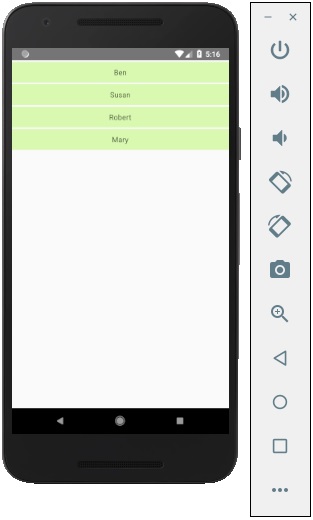
ListView
You can click on each item in the list to trigger an alert with the name.
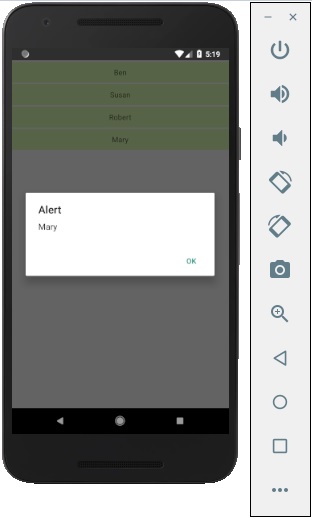
React Native ListView

Comments

  1. This comment has been removed by the author.

    ReplyDelete
  2. The details that you mentioned regarding list view in react native is really great. I have gone through all the screenshots and the code also that you attached as sample and I believe that nothing could explain better than this.
    I was searching for react native development company and got your blog.
    Thanks sharing such a great blog.

    ReplyDelete

Post a Comment

Thank You.

Popular Posts

React Native - Text Input

In this chapter, we will show you how to work with  TextInput  elements in React Native. The Home component will import and render inputs. App.js import React from 'react' ; import Inputs from './inputs.js' const App = () => { return ( < Inputs /> ) } export default App Inputs We will define the initial state. After defining the initial state, we will create the  handleEmail  and the  handlePassword  functions. These functions are used for updating state. The  login()  function will just alert the current value of the state. We will also add some other properties to text inputs to disable auto capitalisation, remove the bottom border on Android devices and set a placeholder. inputs.js import React , { Component } from 'react' import { View , Text , TouchableOpacity , TextInput , StyleSheet } from 'react-native' class Inputs extends Component { state = { ...

An introduction to Size Classes for Xcode 8

Introduction to Size Classes for Xcode In iOS 8, Apple introduced  size classes , a way to describe any device in any orientation. Size classes rely heavily on auto layout. Until iOS 8, you could escape auto layout. IN iOS8, Apple changed several UIKit classes to depend on size classes. Modal views, popovers, split views, and image assets directly use size classes to determine how to display an image. Identical code to present a popover on an iPad  causes a iPhone to present a modal view. Different Size Classes There are two sizes for size classes:  compact , and  regular . Sometime you’ll hear about any.  Any  is the generic size that works with anything. The default Xcode layout, is  width:any height:any . This layout is for all cases. The Horizontal and vertical dimensions are called  traits , and can be accessed in code from an instance of  UITraitCollection . The  compact  size descr...

What are the Alternatives of device UDID in iOS? - iOS7 / iOS 6 / iOS 5 – Get Device Unique Identifier UDID

Get Device Unique Identifier UDID Following code will help you to get the unique-device-identifier known as UDID. No matter what iOS user is using, you can get the UDID of the current iOS device by following code. - ( NSString *)UDID { NSString *uuidString = nil ; // get os version NSUInteger currentOSVersion = [[[[[UIDevice currentDevice ] systemVersion ] componentsSeparatedByString: @" . " ] objectAtIndex: 0 ] integerValue ]; if (currentOSVersion <= 5 ) { if ([[ NSUserDefaults standardUserDefaults ] valueForKey: @" udid " ]) { uuidString = [[ NSUserDefaults standardDefaults ] valueForKey: @" udid " ]; } else { CFUUIDRef uuidRef = CFUUIDCreate ( kCFAllocatorDefault ); uuidString = ( NSString *) CFBridgingRelease ( CFUUIDCreateString ( NULL ,uuidRef)); CFRelease (uuidRef); [[ NSUserDefaults standardUserDefaults ] setObject: uuidString ForKey: @" udid " ]; [[ NSUserDefaults standardUserDefaults ] synchro...